
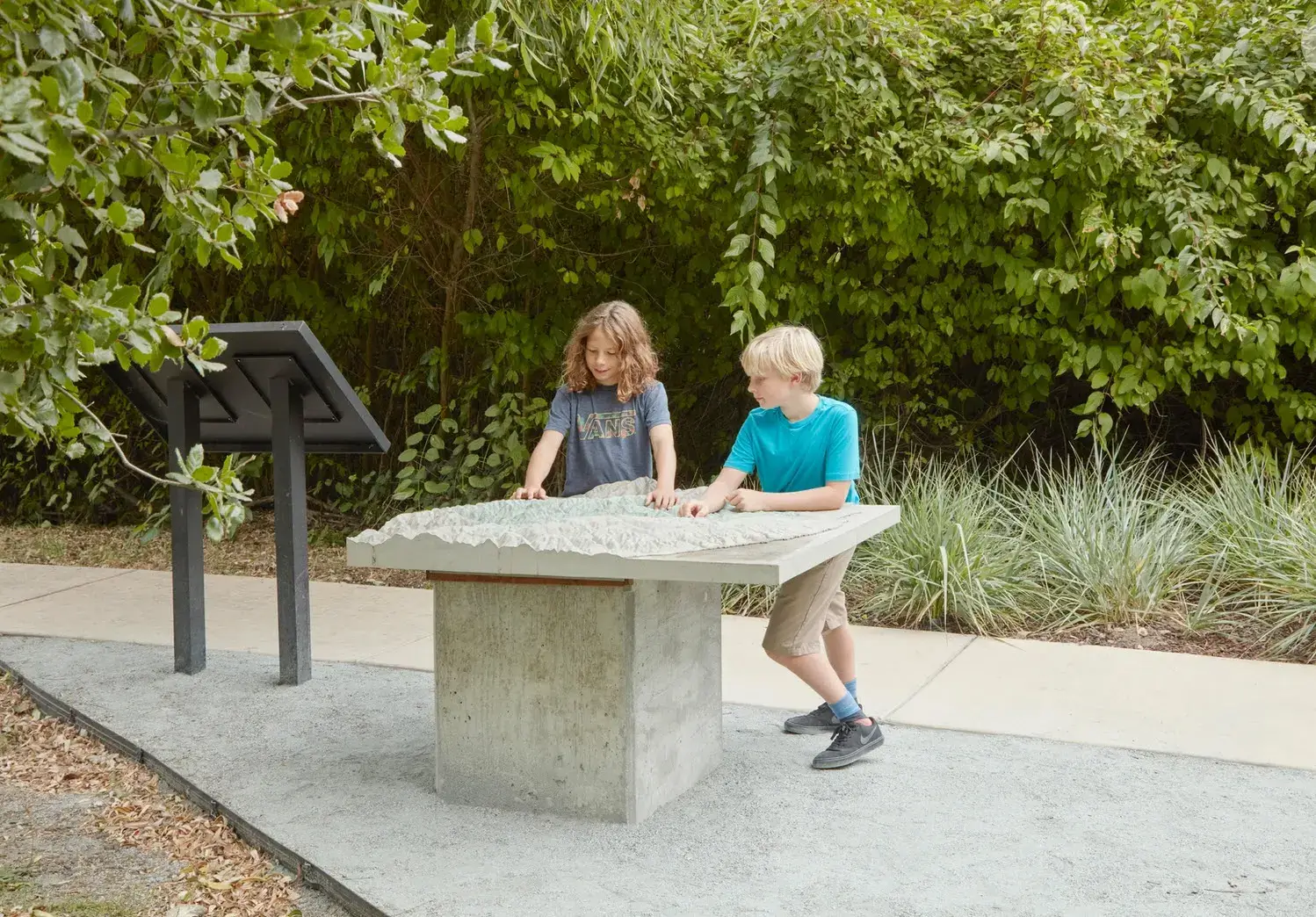
Immerse your audience with 3D raised relief topography maps. These interactive communication tools can be featured in various settings such as educational trail heads and welcome centers, or even provide perspective as engaging feature walls. Real-world three-dimensional raised relief maps can provide clarity, enhance comprehension, and captivate your viewers.
Unlocking Education Potential: The Benefit of 3D Maps
Incorporating a 3D topographic map into your interpretive design plan can improve understanding of complex terrain. Traditional flat trail maps, two-dimensional images, or stylized mountain renderings may not engage your entire audience. A life-sized, tactile 3D display can bridge the gap between abstract knowledge and a genuine connection with the featured area. Effective communication with your target audience is the key, and 3D terrain maps are a potent tool for achieving this goal.
Exploring Materials: Harnessing the Power of Concrete for Watershed Displays
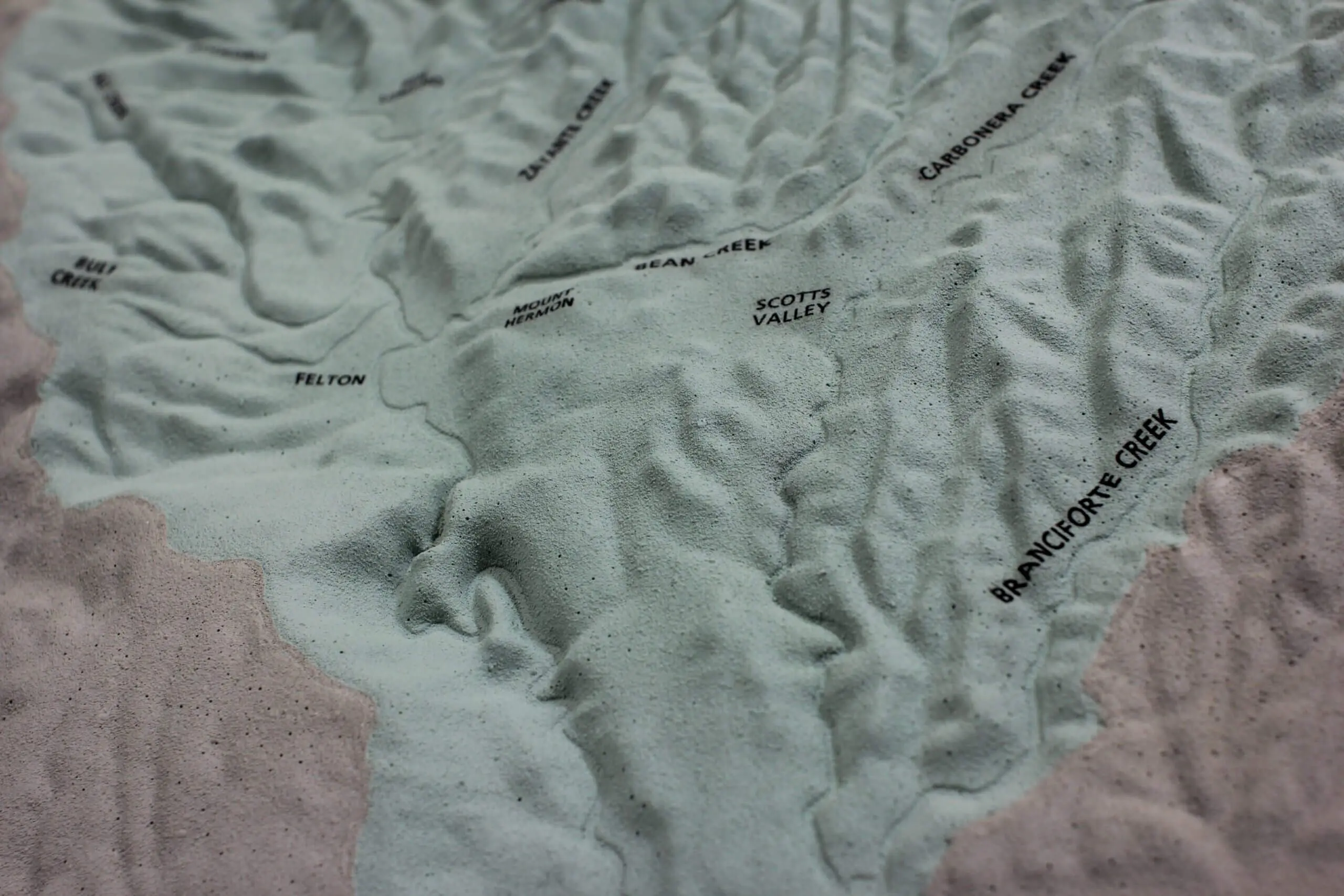
Concrete’s unique properties allow you to simulate real-world watershed flows. Water can be poured directly onto the map’s surface, allowing the water to flow through the tributaries as it would during a rain storm. The material’s natural resilliency makes it an excellent candidate for direct water contact, outdoor displays, and long term use.
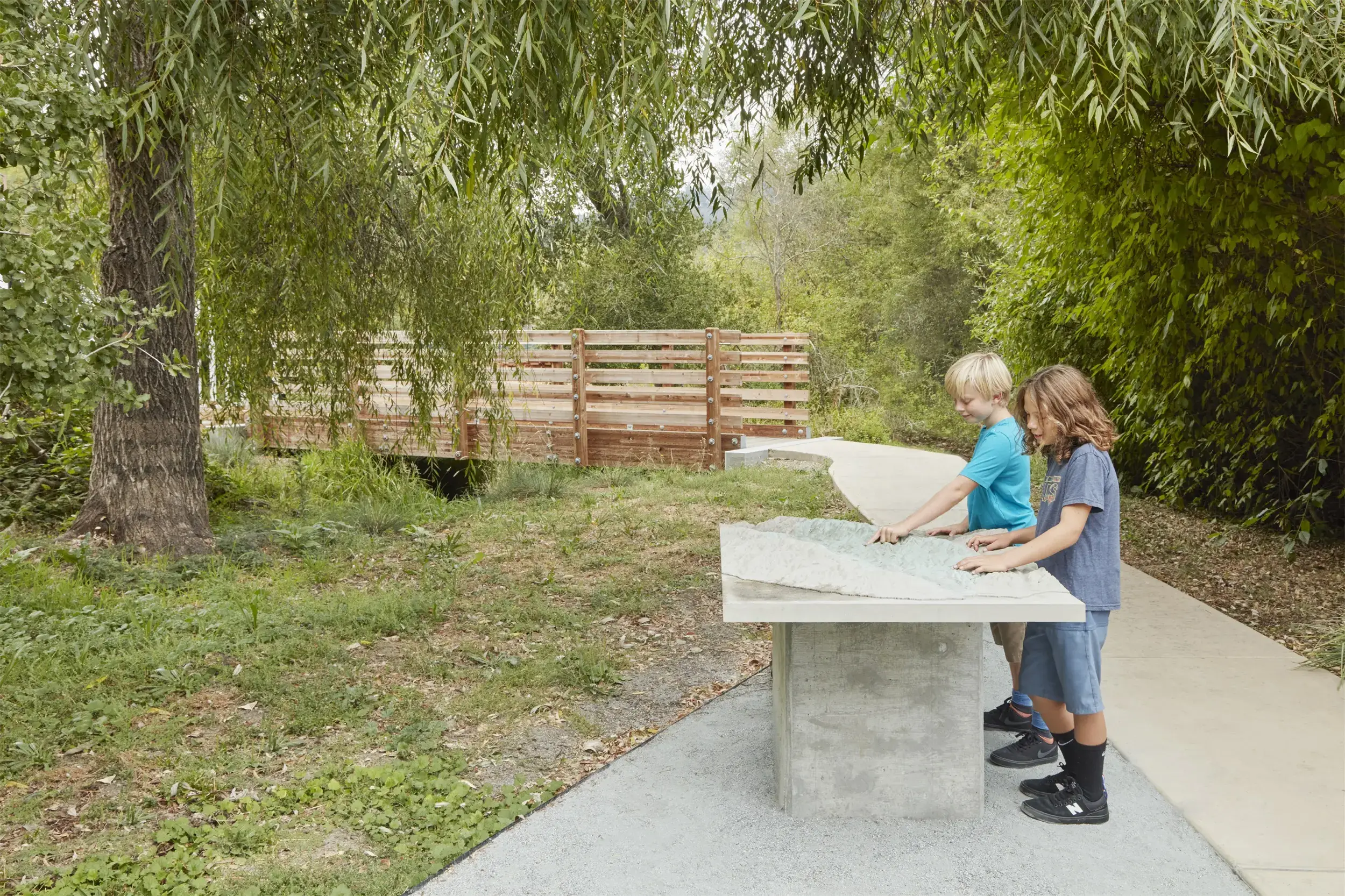
Check out the 3D map example of the San Lorenzo Watershed in California. This outdoor public education display at Felton Discovery Park was a collaborative project involving Base Landscape Architecture, Felton Library, LGM 3D and Kreysler & Associates, showcasing the versatility and impact that a 3D topography display can have on the exhibit’s message. It clearly demonstrates the vital role of water in the community and beyond.
The Difference between Cast Bronze & Concrete for 3D Terrain Maps
Concrete 3D topographic maps offer numerous advantages over traditional cast bronze alternatives. They are weather-resistant and can withstand direct outdoor UV exposure like bronze, but can require much less initial investment than typical bronze cast displays.
These concrete maps are also remarkably lightweight due to the incorporation of fiberglass-reinforced polymer, or FRP, which will ultimately streamlines production, shipment, and installation costs due to this this weight reduction. The concrete’s final color palette can be customized to seamlessly blend with various interior design schemes or brand marketing requirements, making it more versatile compared to its bronze counterpart as well.
Creating Your Own 3D Topographic Map
We start the custom 3D terrain map development with an area of interest (AOI). Our team of Geographic Information System (GIS) specialists can transform JPEGs, flat 2D maps, or Google Earth KMZ files into tangible 3D terrain data. We will then provide expert guidance on refining the overall scale, size, and installation requirements for your 3D map.
Planning for Success with LGM’s Topography Services
No matter your project’s stage, LGM 3D’s topography services are here to assist you. Whether you’re in the initial planning phases or already have construction documents in place, our team is ready to collaborate with you. Don’t hesitate to reach out to us here to start a conversation and explore the limitless possibilities of 3D concrete topography models for your next project. Elevate your design and engage your audience like never before.
On Location photography provided by Base Landscape Architecture & Caitlin Atkinson Photography